90 Days
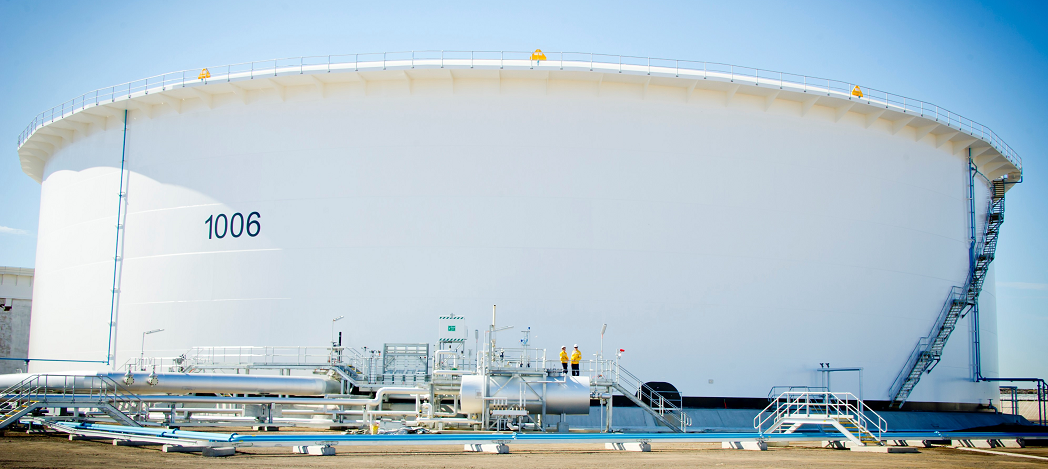
In 1973, the Middle East cut off oil supplies to the world, resulting in fuel shortages, rationing, and a global recession. In response, the International Energy Agency was created in 1974, with a “mandate for oil supply security and policy co-operation, including ... to respond effectively to potential disruptions in oil supply as well as develop energy conservation policies.” Website.
The IEA decided "each IEA country has an obligation to hold oil stocks equivalent to at least 90 days of net oil imports..." Link
Of the 32 members of the IEA, the average is 140 days. Australia has the lowest stockpile available of members and is the only one less then 90 days.
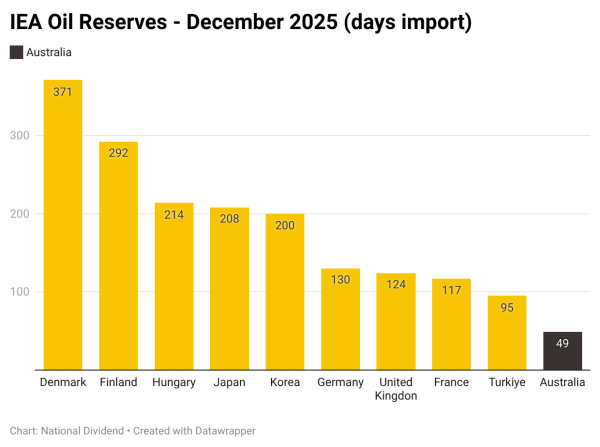
This enables countries that import a lot of their oil, to survive a supply disruption long enough for the situation to resolve, or to find alternatives.
Well, today, we are in an oil shock. 20% of the world's oil passes through this one tiny Strait next to Iran, which is effectively closed. Israel and Iran have been blowing up oil fields, processing facilities and even gas sites, reducing the long-term supply of oil for years and years to come.


Australia
Australia has had half the recommended oil reserves, and much less then most advanced countries who import oil. Even then, we actually do not have a dedicated 'petroleum storage facility' the government owns and can manage. We just ask our suppliers & refineries to hold some extra on the side.
If you are checking the news, fuel supplies are running low already. Remember the panic and shortages during COVID? This will be the same.
 Joseph Sahyoun
But for me, this is still understating it.
Our fuel storage includes all forms, petrol, diesel and jet fuel. Two of which are vital for our national security and defence. If we run out of jet fuel, our expensive F35 fighter jets ($120 million each) become worthless.
The military already knows this and has warned about this before:
A 2013 study Australia’s Liquid Fuel Security: A Report for NRMA Motoring and Services by Air Vice Marshal John Blackburn AO concluded:
"In essence, we have adopted a “she’ll be right” approach to fuel security, relying on the historical performance of global oil and fuel markets to provide in all cases.
Unfortunately, as a result of our limited and decreasing refining capacity, our small stockholdings and long supply chains, our society is at significant risk if any of the assumptions contained in the vulnerability assessments made to date prove false. We would not be the first country to get our assumptions wrong. In that respect, history can be relied upon."
The 2023 Defence Strategic Review, from the government itself, advised:
- "Fuel distribution in the north and northwest must be more effective and less vulnerable....
- Defence must be cognisant of the capabilities of the fuel industry and what it can deliver in a range of circumstances...
- A whole-of-government and industry Fuel Council should progress these critical issues.
- Addressing vulnerabilities, particularly where there are single points of failure and inadequate capacity in key domestic distribution routes, is essential. A variety of alternative supply and storage back-up options needs to be developed to provide a more robust fuel posture."
This did not happen.
Over the years, additional reports have been completed by Australian Strategic Policy Institute, The Lowy Institute and the Navy's RAN Sea Power Centre. All arguing the same requirement - fuel security should be treated as a core defence capability.
If we did this, do you think we would make our largest jet fuel supplier China, who has just cut off all of their fuel exports. A country who has repeatedly banned exports at critical times (COVID etc.), and banned Australian imports, to purposely send us a message.
 Angela Macdonald-Smith, Ayesha de Kretser
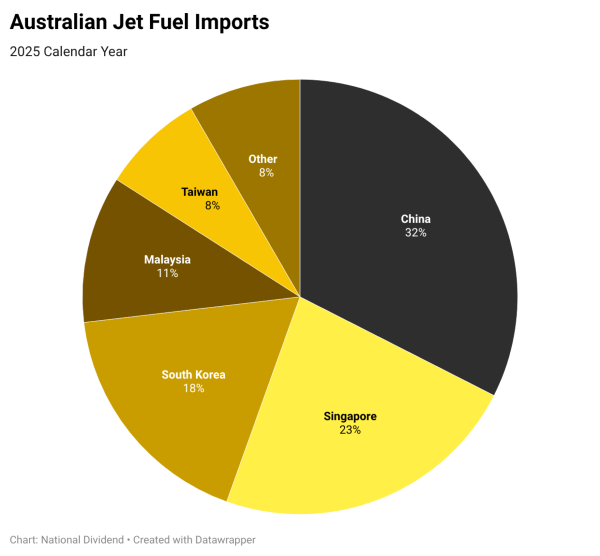
32% of our jet fuel supply has evaporated overnight. As I laid out before, around 70% of Singapore & South Korea's crude inputs come from the middle east. Eventually they will be running low on production.
NATO
NATO thinks this is important. They have spent years and years building up this capability within Europe. They have built The NATO Pipeline System (NPS) during the Cold War to supply NATO forces with fuel.
- The NPS consists of ten distinct storage and distribution systems for fuels and lubricants.
- In total, it is approximately 10,000 kilometres long, runs through 12 NATO countries and has a storage capacity of 4.1 million cubic metres.
- The NPS links together storage depots, military air bases, civil airports, pumping stations, truck and rail loading stations, refineries and entry/discharge points.
NATO again: "Sufficient fuel—encompassing acquisition and contracting, transportation, storage, and distribution—is a necessary foundation for sustaining a combat-credible force."
Japan
Japan is even more dependent on Middle East crude oil (over 90% of all imports), has a great plan and backup system.
They employ a comprehensive three-tier energy security system designed to withstand prolonged supply disruptions, with over 254 days of complete oil supply coverage as of late 2025. Article The foundation layer consists of national stockpiles providing 146 days of supply buffer, maintained directly by government mandate and controlled through Ministry of Economy, Trade and Industry protocols.
What Now
We can no longer keep our head in the sand. The world is well prepared (USA has their enormous SPR, China has over 200 days oil in reserve and still cut off exports!) and laughing at Australia.
Government owned storage facility must be built immediately. To meet the IEA Guidelines of 90 days, Resources Minister Madeleine King said in "that complying with the 90-day requirement would cost $20 billion".
However, benchmarking this against the cost of a small storage buildout at Viva Energy in 2024 (90 million litres costing $80 million) the infrastructure cost would be $10bn, and around $10bn at current prices to fill it up (but you wouldn't do that now).
An older estimate cited by the Lowy Institute estimated around $7bn capital required for a storage solution.
While that sounds like a lot, remember we are spending $368bn on AUKUS Nuclear Submarines, to "protect and defend vital trade routes, sea lines of communication and sovereign maritime approaches. REPORT
I imagine it would be hard to defend our country with only nuclear submarines and no fuel for our fighter jets, reconnaissance planes, boats, tanks or trucks!
Or compared to the Federal Government's budget ($768bn each year), $10bn to start the capital works = 1.3%.
We can easily afford meeting our IEA compliance requirement at 90 Days.
We have just chosen not to.